
Theme: Education
Published: 2026
South Africa’s gender learning gap starts early – and keeps growing in primary school
New research shows that not only do girls start school ahead of boys in language and Mathematics, but the gap grows during the first four years of schooling.
By Gabrielle Wills and Ros Clayton
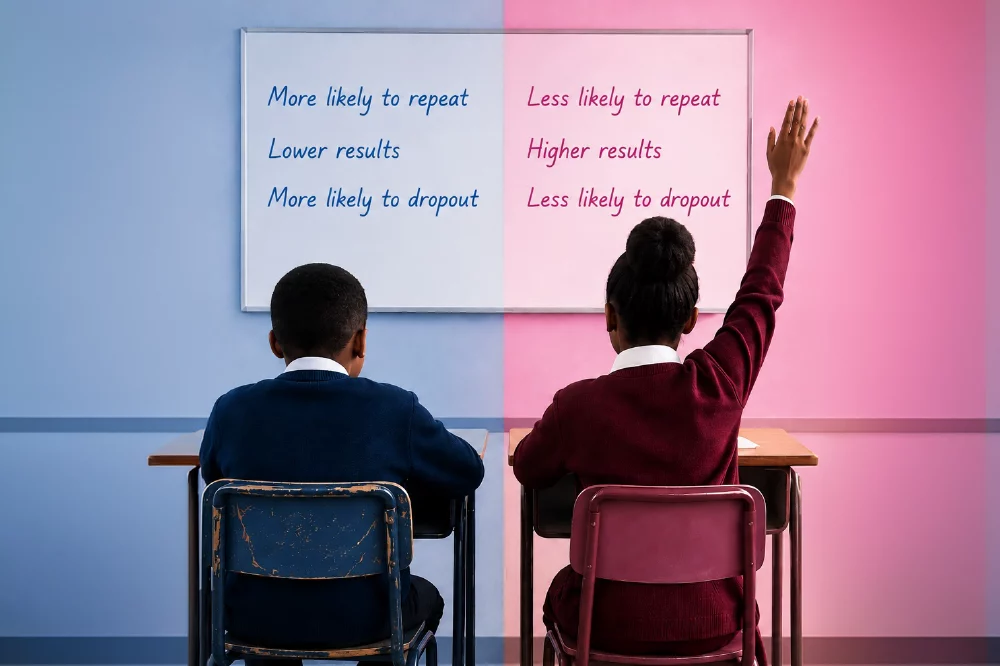
In South Africa, girls are generally outperforming boys at school. And this difference has been growing over time. Girls tend to outperform boys in reading and language internationally, while boys often have a small advantage in Mathematics. South Africa is somewhat unusual: in recent international assessments, girls significantly outperform boys in both early literacy and Mathematics.1,2
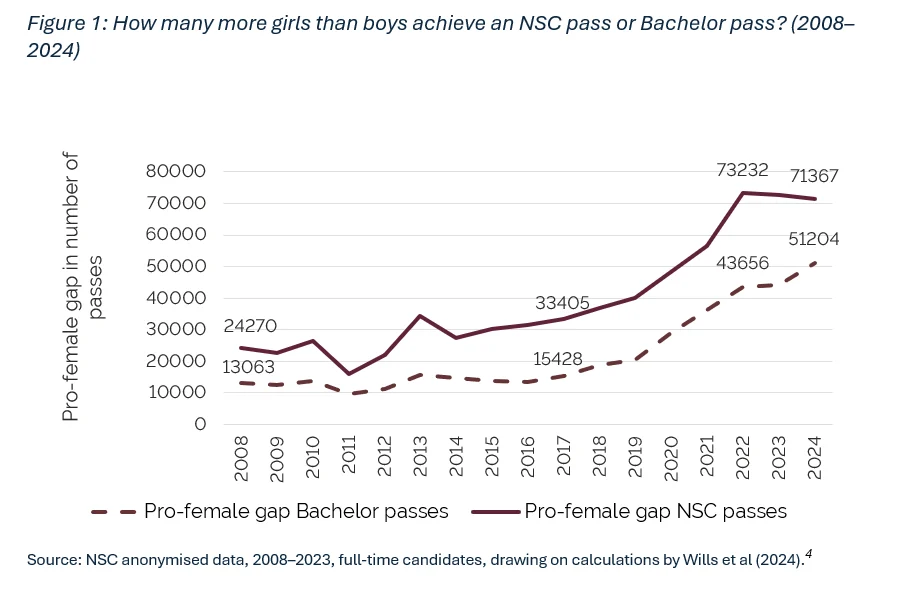
The consequences extend beyond primary school. In 2024, around 70,000 more girls than boys passed the National Senior Certificate (NSC) and 51,000 more girls than boys achieved a Bachelors pass. Leaving school without an NSC limits opportunities for further education and employment.3
But when do these gender gaps emerge? And do they grow as children progress through school?
Our study commissioned by the Gates Foundation titled Growing Apart: Tracking the Pro-Girl Achievement Gap Across Early Grades in South African Primary Schools, follows more than half a million learners from Grade 1 through to Grade 4.5
The findings reveal that girls are already ahead when they enter school and their lead grows, particularly in language subjects and less resourced schools.
What happens to the gender gap during primary school?
Most large-scale assessments, including PIRLS and TIMSS, give us a snapshot of how boys and girls perform at a particular age or grade. They cannot show how gaps change as the same children progress through school.
Using Data Driven Districts (DDD) administrative data, we follow over 500,000 learners who entered Grade 1 in 2019 through to Grade 4, across public schools in Eastern Cape, Gauteng, KwaZulu-Natal, Limpopo, Mpumalanga and North West.
We examine learners’ school marks in Home Language, First Additional Language (which is typically English) and Mathematics, accounting for differences between their ages and the characteristics of the schools they attend.
Girls start ahead – and their lead grows
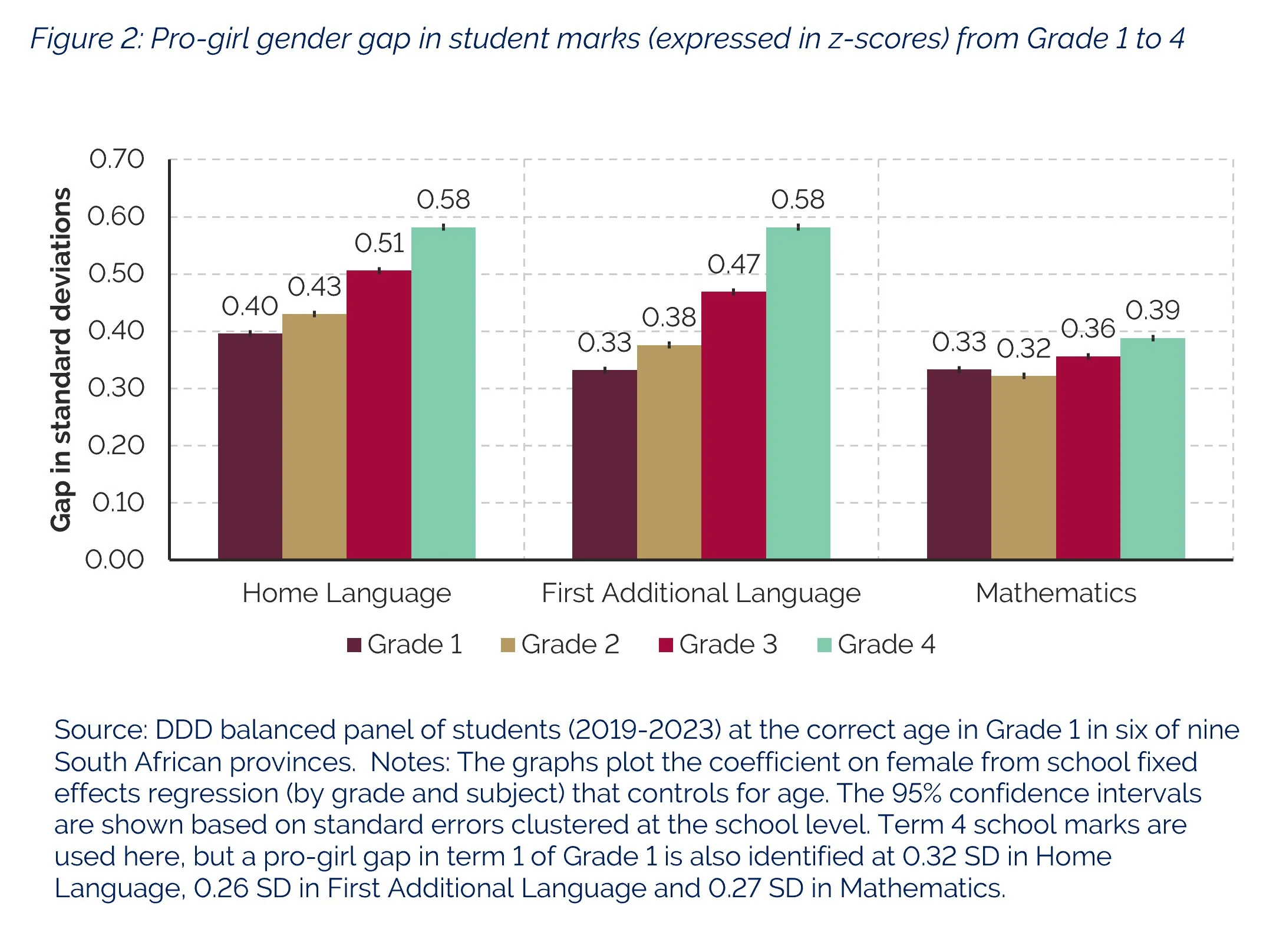
That girls are already outperforming boys in Grade 1 is consistent with existing evidence from surrounding grades.6 What is striking is that the pro-girl advantage in student marks increases substantially as learners move through primary school, especially in language subjects
As shown in Figure 2, in Grade 1 girls score approximately 0.4 standard deviations higher than boys in Home Language and 0.34 standard deviations higher in First Additional Language. By Grade 4, the gap in both subjects has grown to approximately 0.58 standard deviations.
A gap of 0.58 standard deviations is about 9 percentage points in these marks, or equivalent to roughly one achievement (code) level. The gap in Mathematics is smaller but follows a similar pattern: By term 4 of Grade 1 girls have a school mark advantage of 0.34 standard deviations which increases modestly to 0.39 by Grade 4.
The gender gap is much larger in poorer schools
Not all boys are falling behind to the same extent.
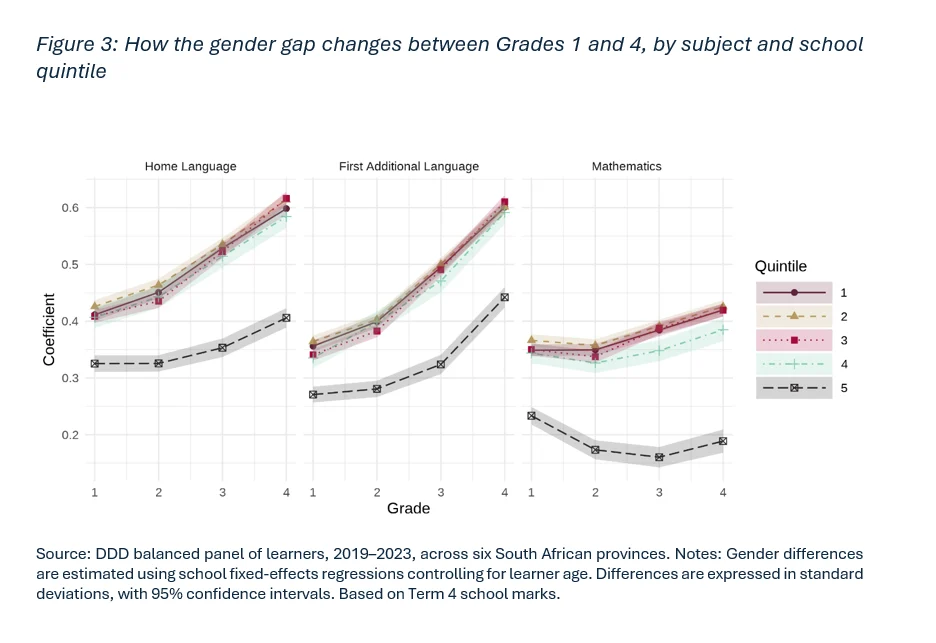
South African public schools are classified into five socioeconomic quintiles, with Quintile 1 representing the poorest schools and Quintile 5 the wealthiest.
When we examine the gender gap separately across these groups, an important pattern emerges (see Figure 3). In Grade 1, girls already have a larger advantage in their marks in schools serving poorer communities – Quintiles 1 to 4 – than in the wealthiest schools (Quintile 5). Over the next three grades, these differences become more pronounced. The gender gap in student marks grows much more rapidly in less-resourced schools, while remaining considerably smaller in Quintile 5 schools.
These results show that gender and socioeconomic disadvantage interact in ways that leave boys in poorer schools particularly vulnerable to falling behind.
The weakest learners are falling furthest behind
The gender gap is generally largest among the weakest-performing learners.
In Grade 1, girls outperform boys throughout the distribution, but especially among those with the lowest marks. The pattern changes in Grade 2, when the gender gap is relatively similar across the distribution. One possible explanation for this is the much higher rate at which boys repeat Grade 1. Previous research suggests that repeating an early grade can improve subsequent learning outcomes, which may temporarily narrow the difference between boys and girls.7 By Grades 3 and 4, the gap is again largest among the weakest learners.
Why are boys falling further behind?
Part of the explanation may lie in differences that emerge before children start school.
International studies find that girls develop certain language and social-emotional skills earlier than boys.8 South African evidence also shows gender differences in developmental outcomes before school entry.6 These differences may help explain girls’ initial advantage in language, attention and classroom behaviour, but not necessarily why the gap grows.
Our study documents the widening gap but cannot establish its causes. But one possibility is that the school environment interacts differently with boys’ and girls’ developmental needs. Differences in classroom experiences, teaching practices, teacher assessment biases or the support available to struggling learners could also play a role.
Age may matter too. A child’s age when entering school can have important consequences for repetition and academic performance.9 Understanding how age, gender, and school socio-economic status interact could help explain why some boys are especially vulnerable to falling behind.
More research is needed to identify the factors driving these widening gaps and which of them schools can address.
How can we help boys catch up?
The immediate priority is better support for all children struggling with foundational skills, especially literacy. Structured early-grade reading programmes, teacher support and learning materials can improve achievement, including in under-resourced schools.10-13
These programmes need not target boys specifically. Because boys are more likely to be among the weakest learners, effective support could benefit more boys while helping struggling girls too.
But remedial support is only part of the answer. We also need to understand why boys, particularly those in poorer schools, are falling further behind during the early years of education. Identifying the broader curriculum, assessment, social and schooling factors contributing to these differences could help prevent learning gaps from widening in the first place.
Closing the gap could improve opportunities well beyond school
The gender gap in South African education is well established. Our study adds evidence using school marks to suggest that the large gender differences observed in national and international assessments are not simply a reflection of differences that exist when children first enter school. Gaps in student marks continue to widen during the first four years of schooling, especially in poorer schools and among the weakest learners. But international studies indicate that gaps can alter into adolescence14. So, the next stage of our research is to examine whether gaps converge or diverge at the secondary level.
But understanding why the gap grows in the primary grades, and acting early to prevent it, is an important step towards giving every child a better chance to succeed. By supporting weaker learners keep pace from the earliest grades, South Africa could improve learning outcomes for everyone while reducing the number of boys who dropout at the secondary level and do not pass the National Senior Certificate.
Read the policy brief here and working paper here.
References
1 Spaull, N. & Makaluza, N. Girls Do Better. Agenda 33, 11–28 (2019). https://doi.org/10.1080/10130950.2019.1672568
2 Wills, G. Gender and equity in South African education. (Research on Socio-Economic Policy, Stellenbosch University, Stellenbosch, 2025).
3 Köhler, T. A Paradox of Progress: Rising Education and Unequal Labour Market Returns in Post-Apartheid South Africa. (Research on Socio-Economic Policy, Stellenbosch University, Stellenbosch, 2024).
4 Wills, G., Selkirk, R. & Kruger, J. School completion, the matric and post-school transitions in South Africa. (Research on Socio-Economic Policy, Stellenbosch, 2024).
5 Wills, G. & Clayton, R. Growing Apart: Tracking the Pro-Girl Achievement Gap Across Early Grades in South African Primary Schools. (Research on Socio-Economic Policy, Stellenbosch University, Stellenbosch, 2026). http://dx.doi.org/10.2139/ssrn.6912519
6 Giese, S. et al. Thrive by Five Index 2024: National Findings. (DataDrive2030, Cape Town, 2025).
7 Clayton, R. The impact of early grade repetition on test scores: Evidence from a regression discontinuity design in South Africa. (Research on Socio-Economic Policy, Stellenbosch University, Stellenbosch, 2025).
8 Bando, R., Lopez-Boo, F., Fernald, L., Gertler, P. & Reynolds, S. Gender Differences in Early Child Development: Evidence from Large-Scale Studies of Very Young Children in Nine Countries. Journal of Economics, Race, and Policy 7, 82–92 (2024). https://doi.org/10.1007/s41996-023-00131-1
9 Böhmer, B. An unequal start: The impact of school-entry age on grade repetition and academic performance in Grades 1 – 4. (Research on Socio-Economic Policy, Stellenbosch University, Stellenbosch, 2026).
10 Taylor, S., Cilliers, J., Prinsloo, C., Fleisch, B. & Reddy, V. Improving early grade reading in South Africa. 3rd Grantee Final Report., (International Initiative for Impact Evaluation, New Delhi, 2018).
11 Taylor, S., Mohohlwane, N., Böhmer, B. & Murru, A. Key findings from a series of studies on structured learning programmes in South Africa. (What Works Hub for Global Education. Synthesis report. 2025/004, 2025).
12 Stern, J. M. B. et al. Persistence and emergence of literacy skills: Long-term impacts of an effective early grade reading intervention in South Africa. Journal of Research on Educational Effectiveness 19, 1–22 (2026). https://doi.org/10.1080/19345747.2024.2417288
13 Ardington, C. Funda Wande Limpopo Workbooks Evaluation. Endline Report. April 2024., (SALDRU, University of Cape Town, Cape Town, 2024).
14 Borgonovi, F., Choi, A., & Paccagnella, M. (2021). The evolution of gender gaps in numeracy and literacy between childhood and young adulthood. Economics of Education Review, 82, 102119. ttps://doi.org/10.1016/j.econedurev.2021.102119